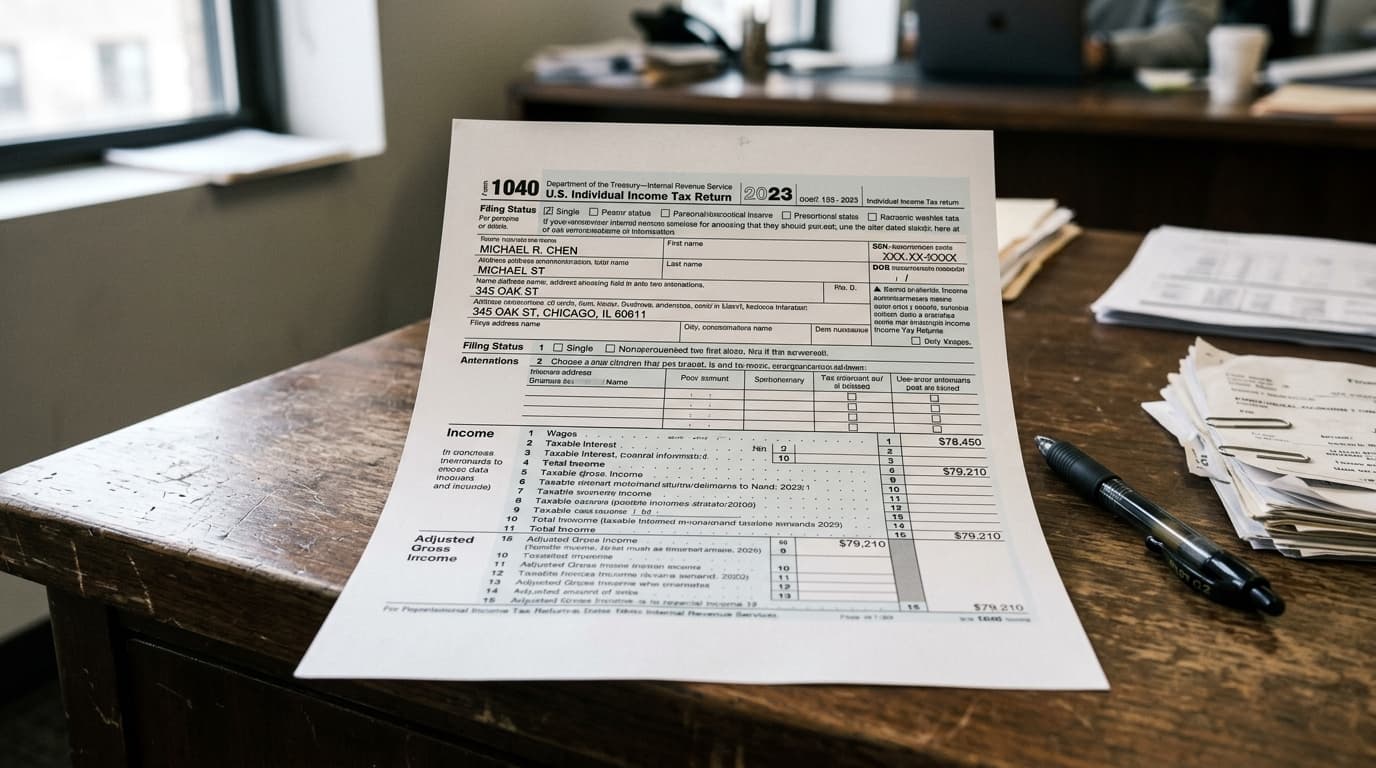
The Form 1040 changes for the 2026 filing season include a higher standard deduction, a brand-new deduction for taxpayers 65 and older, and first-time deductions for tips, overtime pay, and car loan interest. The IRS also made the qualified business income deduction and casualty loss deduction permanent, while premium tax credit rules shifted and several older credits expired for 2026 returns.
TL;DR
- The 2026 standard deduction rises to $32,200 (married filing jointly), $16,100 (single/MFS), and $24,150 (head of household), per the IRS.
- New deductions for qualified tips (up to $25,000), qualified overtime (up to $12,500, or $25,000 joint), and vehicle loan interest (up to $10,000) show up on 2026 returns.
- The QBI deduction and casualty loss deduction are now permanent, but the IRS says certain other credits expired and premium tax credit rules changed.
What Are the Form 1040 Changes for 2026?
The form 1040 changes 2026 brings are mostly driven by inflation adjustments and provisions tied to recent tax legislation, not a redesign of the form itself. The IRS's own summary of 2026 updates lists a higher standard deduction, new individual deductions for tips, overtime, and vehicle loan interest, a permanent QBI deduction, an expanded casualty loss deduction, changed premium tax credit rules, and updated information return codes for tips and overtime reporting.
None of these changes require a new form layout, but they do change what you ask clients for and how you check their returns. If you run a tax-prep workflow with a lot of manual document chasing, this is the season to tighten it. Our tax prep workflow SOP template is a good starting point if your intake process still relies on memory instead of a checklist.
What Are the New 2026 Standard Deduction Amounts?
For tax year 2026, the IRS sets the standard deduction at $32,200 for married filing jointly, $16,100 for single and married filing separately, and $24,150 for head of household. That is the baseline every other 2026 deduction layers on top of, so it is worth confirming clients understand it before you talk about itemizing.
| Filing Status | 2026 Standard Deduction |
|---|---|
| Married Filing Jointly | $32,200 |
| Single / Married Filing Separately | $16,100 |
| Head of Household | $24,150 |
These figures come directly from the IRS 2026 inflation adjustments release. Clients near the itemizing threshold will want to know these numbers before they hand you a shoebox of receipts.
What New Deductions Show Up on the 2026 Form 1040?
Four new or expanded deductions land on the 2026 Form 1040: a senior deduction, a qualified tips deduction, a qualified overtime deduction, and a passenger vehicle loan interest deduction. Each has its own dollar cap and, in some cases, a phase-out based on income.
| Deduction | 2026 Cap | Phase-Out |
|---|---|---|
| Senior deduction (65+) | $6,000 per person / $12,000 joint | Above $75,000 (single) / $150,000 (joint) MAGI |
| Qualified tips | Up to $25,000 | Set by IRS guidance on qualifying occupations |
| Qualified overtime | Up to $12,500 / $25,000 joint | Set by IRS guidance |
| Vehicle loan interest | Up to $10,000 | Applies to qualified passenger vehicle loans |
The senior deduction runs for tax years 2025 through 2028 and applies whether or not the client itemizes, according to the IRS filing season update for seniors. The tips and overtime deductions are new enough that the IRS updated information returns and occupation codes to capture them separately, so you will need clean W-2 and 1099 data broken out by category rather than a single wage figure. If any of your clients also received tip income tied to service jobs, our breakdown of no tax on tips and 2026 W-2 reporting covers the mechanics of how that shows up on the wage statement itself.
What Changed for Itemized Deductions and Charitable Contributions?
For 2026, cash contributions to eligible tax-exempt organizations remain deductible, but charitable contributions only count once they exceed 0.5% of adjusted gross income, and overall itemized deductions can be reduced above a certain income level. That 0.5% floor is new enough that a client who has always itemized their giving might be surprised their deduction is smaller this year even if their donations stayed flat.
This is a good moment to walk high-income itemizers through the math before you file, not after. If your firm still handles this kind of client conversation over email chains, our accounting firm email templates library has a few starting points for explaining deduction changes without writing a new note from scratch every time.
What Else Changed on the 2026 Return: QBI, Casualty Losses, and Expired Credits?
The qualified business income deduction is now permanent, the casualty loss deduction is now permanent and expanded to cover losses tied to a state-declared disaster, and the IRS says certain other credits expired and can no longer be claimed on the 2026 return. The QBI change matters most for pass-through business owners, since it removes the year-to-year uncertainty about whether the deduction would still exist.
The casualty loss expansion is worth flagging to any client who filed an insurance or disaster claim in 2026, since state-declared disasters now qualify even when a federal declaration was not issued. Premium tax credit eligibility and repayment amounts for excess advance payments also changed for 2026, so anyone with marketplace coverage needs a fresh look rather than last year's numbers carried forward. If bonus depreciation questions come up alongside QBI for your business-owner clients, our post on 100% bonus depreciation for 2026 covers that piece separately.
When Will the 2026 Form 1040 and Instructions Be Available?
The IRS lists Form 1040 (2025), the version used for returns filed during the 2026 season, with a posted date of January 2, 2026, and the full instructions posted February 27, 2026. That six-week gap between the form and the instructions is common, but it means firms filing early season returns need to lean on IRS guidance and prior-year instructions for edge cases until the full instructions land.
If you have clients who typically push toward the October extension deadline, that gap is one more reason to hold off rather than rush a return before the instructions catch up. Our guide on the October 2026 extension deadline and what can wait lays out which pieces are safe to defer.
How AI Helps You Get Ahead of the Form 1040 Changes for 2026
Every change above turns into extra manual work at intake and review unless you build it into your process now. An AI assistant like Claude or ChatGPT can read a client's W-2s and 1099s and flag whether they likely qualify for the new senior, tips, overtime, or vehicle loan interest deductions before you open the return, which cuts down the back-and-forth of asking for documents you did not know you needed.
The same assistant can draft a plain-language client note explaining why their itemized charitable deduction shrank under the new 0.5% AGI floor, so you are not writing that email from scratch for every affected client. It can also cross-check phase-out thresholds against a client's MAGI automatically, catching the case where someone assumes they qualify for the full senior deduction but actually falls into the phase-out range. And for extension clients, it can track which documents are still missing against the new reporting categories for tips and overtime, so your team spends less time re-chasing the same client twice.
Which of these fits your firm depends on your current intake process, your software stack, and how many returns are affected by each change, and that is exactly what a free CloseRadar operations audit is built to figure out: answer a short questionnaire and get back the specific tools and quick wins for your firm, no credit card and no sales call.